Humanities
Humanities at JPC encourages and challenges students to consider their place within the world around them, assisting them to develop a greater understanding of its complexity and their role in the future.
| Humanities subjects foster an appreciation of past and present cultures, and the ways that people connect with their environments, through studies of human behaviour and interaction in social, cultural, environmental, economic and political contexts. Through studying Humanities, students will develop the ability to question, think critically, solve problems, communicate effectively, make decisions and adapt to change. Thinking about and responding to issues requires an understanding of the key historical, geographical, political, economic and societal factors involved, and how these different factors interrelate. Inquiry, research and 21st-century skills developed throughout the Humanities are transferable to many areas of students' studies, enabling them to be empathetic, global citizens forming their own pathways to personal and professional success.
|
Vocational Education and Training qualifications provide a fantastic opportunity for students to acquire new skills and competencies that will increase their knowledge of the world of work while also gaining valuable employability skills.
Mrs Jacqlyn Rasmussen, Vocational Education Program Co-ordinator
Humanities Subject Offerings
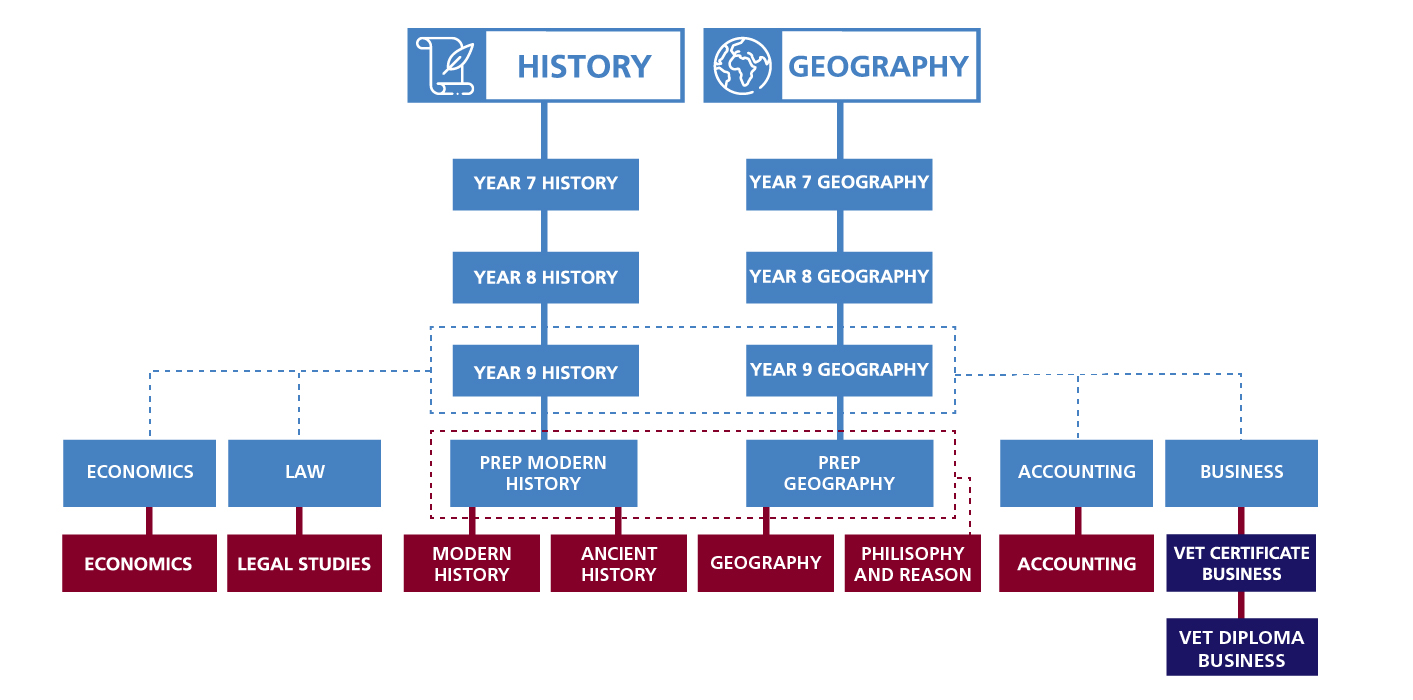
The variety of Humanities subjects offered vary by year level and include:
Geography (Years 7 to 12)
Geography is the study of people and places, including the physical features of the earth and its atmosphere, and of human activity including the distribution of populations and resources and political and economic activities. It encourages students to become informed and adaptable, so they develop the skills required to interpret global concerns and shape change for a socially just and sustainable future.
History (Years 7 to 12)
History is a study of the past which aims to shape and influence students’ attitudes and actions in the present and the future. It promotes the understanding of societies, ideas, movements and experiences that have shaped humanity from earliest times and helps students to appreciate how the world and its people developed their thinking about events of today.
Accounting (Years 10 to 12)
Accounting deals with the management of financial resources for both business and for individuals. It teaches a way of systematically organising, analysing and communicating financial data and information for decision-making.
Economics (Years 10 to 12)
Economics is the study of how to allocate and distribute scarce resources on a national and global scale to maximise wellbeing. It challenges students to use evidence for innovation and problem-solving in order to make good decisions when considering complex global relationships and trends.
Legal Studies (Years 10 to 12)
Legal Studies focuses on how the legal system regulates activities to regulate the rights of individuals, while balancing these with obligations and responsibilities. The dynamic nature of law allows students to explore its role and development in response to current issues on local, national and international scales.
Vocational Education and Training (VET) - Certificate 3 in Business/Diploma of Business (Years 10 to 12)
The flexibility of the Queensland Certificate of Education (QCE) allows students to embrace a number of different pathways to education and training while still attending school. VET Learning Options are suited to students who are interested in both ATAR-eligible and ineligible pathway options beyond senior secondary schooling.
Interested in Secondary School at JPC?
Complete the form below and our team will be in touch to help you explore your options.