3.1 Programs Organisation and Structure
3.2 Information Communication and Technologies (ICT)
3.3 Diverse Learning (and Extension Program)
3.4 Homework and Home Learning Philosophy and Expectations
3.5 Assessment and Reporting
3.6 Academic Awards
3.7 Scholarships
3.1 Programs Organisation and Structure
Primary School
The Primary School learning program is designed to engage students in learning that is relevant, engaging, significant, and challenging. As an authorised IB School, our philosophy is based on an inquiry-based approach to teaching and learning principles that develops globally significant conceptual understandings.
Through the IB PYP Programme, we incorporate the Australian Curriculum and Early Years Learning Framework requirements. The PYP Framework provides an excellent vehicle for delivering the Australian Curriculum while also giving students a unique global outlook and providing subject depth and breadth. The PYP Curriculum Framework documents what is to be taught through the Australian Curriculum Content Descriptors and the quality of learning expected of students, as described in the Australian Curriculum
Achievement Standards.
An inquiry-based approach enables our students to develop conceptual understandings that transcend traditional subjects and apply their knowledge across a transdisciplinary framework. What matters is not recalling discrete pieces of factual knowledge, but developing our students' capability to take what they have learnt and transfer it to new situations. Furthermore, there is a strong emphasis on academic rigour where students are challenged to develop deep understandings about locally and globally significant issues.
Learning through inquiry complements the rigorous approach we adopt to developing students' Literacy and Numeracy skills. This approach strengthens the purpose and application of developing these foundational capabilities. While building foundational skills through inquiry, our students participate in blocks of learning dedicated to explicit, scaffolded teaching of the knowledge and skills required for Literacy and Numeracy.
Our current programs cater to individual differences, in line with the College's developmental philosophy. Teaching and learning experiences are differentiated to meet a diverse range of learning needs and abilities. Ongoing assessment for learning is undertaken to determine the following learning goals. A variety of teaching strategies and approaches are utilised to cater to individual learning styles and interests.
Our teachers take personal and collective responsibility for improving student learning. We place a strong emphasis on building all staff capacity through ongoing professional education. The teaching staff have high levels of pedagogical knowledge to meet all learning needs in the classroom. Our Diverse Learning Team provide additional support to both teachers and students through input designed to enhance and strengthen the differentiated curriculum for all students.
JPC has an extensive range of specialist subjects that are timetabled into the weekly program. These subjects include Health and Physical Education, Music, Visual Arts, Spanish and Chinese. The Noelene Munns Learning Centre (NMLC) is a state-of-the-art facility with a library and a range of digital and design technologies.
PYP
PYP is a transdisciplinary programme of international education designed to foster the development of the whole child.
The PYP programme:
- is for students between the ages of 3 and 12
- encompasses academic, social, physical, emotional, spiritual and cultural needs
- combines the best research and practice in education to create a relevant, engaging, significant and challenging educational framework for all students
- promotes the application of knowledge, development of conceptual understanding and the mastery of skills
- promotes inquiry
- strikes a balance between the traditional subject disciplines and the transdisciplinary Programme of Inquiry
- encourages students to become active, compassionate and lifelong learners who understand and embrace differences; requires ongoing, authentic assessment and reflection.
The PYP Framework
The PYP is a curriculum framework with five essential elements: knowledge, concepts, skills, attitudes and action. The knowledge component is developed through the transdisciplinary Programme of Inquiry and the individual subject disciplines.
The Programme of Inquiry consists of six individual Units of Inquiry at each year level under the following transdisciplinary themes:
- Who We Are
- Where We Are in Place and Time
- How We Express Ourselves
- How The World Works
- How We Organise Ourselves
- Sharing the Planet.
The Units of Inquiry are developmentally appropriate for each phase of learning and build on knowledge from previous years. Specialist teachers collaborate with classroom teachers to develop Units of Inquiry and teach their own disciplines.
The teaching and learning methodology is based on the constructive approach and inquiry-based learning. Teachers ascertain what the students already know about the topic under investigation and then guide the inquiry by building on prior knowledge. This enables the teacher to tailor the learning program to meet individual needs.
PYP Concepts
Central to the philosophy of the PYP is the principle that purposeful, structured inquiry is a powerful vehicle for learning that promotes meaning and understanding and challenges students to engage with significant ideas. This is achieved through a concept-driven curriculum, which is important in designing a transdisciplinary curriculum.
The PYP concepts are:
-
Form:What is it like?
-
Function:How does it work?
-
Causation:Why is it as it is?
-
Change:How is it transforming?
-
Connection:How is it linked to other things?
-
Perspective:What are the points of view?
-
Responsibility:What are our obligations?
Approaches to Learning
Approaches to Learning (ATLs) are deliberate strategies, skills and attitudes that permeate the IB teaching and learning environment.
The IB approaches to learning skills are:
- Thinking Skills
- Research Skills
- Social Skills
- Communication Skills
- Self-management Skills
The IB approaches to teaching skills are:
- based on inquiry
- focused on conceptual understanding
- developed in local and global contexts
- concentrated on effective teamwork and collaboration
- differentiated to meet the needs of all learners
- informed by formative and summative assessment.
Action
In the PYP, it is believed that education must extend beyond the intellectual to include socially responsible attitudes and thoughtful and appropriate action. The PYP explicitly expects that successful inquiry leads to responsible action initiated by students through their learning. JPC students are given the opportunity and power to choose to act, decide on their actions, and reflect on them to make a difference.
Secondary School
Academic Welfare and academic structures have been established to provide a sound system of support, guidance, and supervision of students. To closely monitor student development, the College is divided into different schools. The following roles ensure students are well catered for in their learning and holistic development:
- The Deputy Principal - Head of Secondary has responsibility for promoting the learning and welfare of all students in Years 7 to 12
- The Dean of Studies is responsible for student academic progress through Year 7 to 12. The Dean of Studies is also responsible for overseeing assessment and reporting, along with leading a successful vocational and careers program
- The Dean of Academic Welfare provides leadership and management in all areas associated with student welfare in the Secondary School. The Dean of Academic Welfare is also responsible for the provision of a supportive environment where all students can thrive
- The Dean of Pedagogy is responsible for developing teacher capability and ensuring teachers have the opportunity to stay current with 'Best Teaching Practice' as enunciated in the latest research
- Heads of Year assist the Dean of Academic Welfare. The Head of Year has particular responsibility for their year level, allowing a deeper knowledge of each student's academic welfare.
The daily monitoring of a student's progress is the immediate responsibility of the Academic Welfare (AW) teacher who meets regularly with the Academic Welfare class. The Academic Welfare teacher knows the student best and should be the student's and parents' first point of contact for problems or queries.
In the Secondary School, academics are organised into faculty areas, each under the control of a Head of Faculty responsible for the administration and supervision of various subjects. Students and parents should contact the class teacher for assistance in a subject area and the Head of Faculty if further information is required.
Education is a shared experience between the College and home. Parents are encouraged to contact their son or daughter's Academic Welfare teacher or specific subject teacher to discuss any aspect of their progress.
ACADEMICS: The Curriculum
The curriculum at JPC is dynamic, practical and ongoing. It constantly strives to ensure that our students' learning is meaningful, developmental and purposeful. The curriculum is guided by the College's statement of 'What We Believe', which is displayed in every Secondary School classroom.
JPC is a learning community in which all members have the opportunity to reach their individual potential for living a contributing and fulfilling life. Our community grows in an environment where our values are embraced, where mutual respect demands a hospitality that reaches out and welcomes those of all cultures and faiths, and where excellence in every endeavour is sought and applauded.
The College is committed to providing a seamless, integrated curriculum from Kindergarten through to Year 12, maintaining a developmental philosophy and consistency through the College's Educational Framework.
Educational Framework
We aim to provide a continuous learning journey for all students. In defining our educational framework, we begin with the student who is at the centre of all learning at JPC.
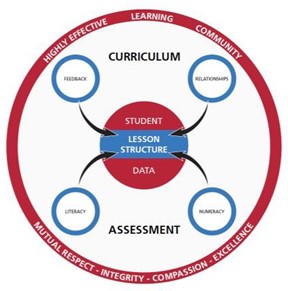
| To understand how best to support a student's learning, teachers must also know how they learn and what success they have had in the past. Teachers can then develop programs and lessons that support students. The diagram above highlights these concepts by having the student and his/her data at the centre. Students will engage in relevant and varied learning experiences (lesson structure) that are shaped by the Australian curriculum and Queensland syllabus documents. The curriculum offered at JPC focuses on literacy and numeracy, but it does more than teach students to read and write; it encourages them to analyse, draw inferences, and assess written information, and it incorporates 21st-century literacies across the curriculum. |
To understand how best to support a student's learning, teachers must also know how they learn and what success they have had in the past. Teachers can then develop programs and lessons that support students.
The diagram above highlights these concepts by having the student and his/her data at the centre. Students will engage in relevant and varied learning experiences (lesson structure) that are shaped by the Australian curriculum and Queensland syllabus documents. The curriculum offered at JPC focuses on literacy and numeracy, but it does more than teach students to read and write; it encourages them to analyse, draw inferences, and assess written information, and it incorporates 21st-century literacies across the curriculum.
Queensland Certificate of Education (QCE)
Students may be eligible for a QCE at the end of their senior schooling. Students who do not meet the QCE requirements can continue to work towards the certificate post-secondary schooling. The QCAA awards a QCE in the following July or December, once a student becomes eligible. Learning accounts are closed after nine years; however, a student may apply to the QCAA to have the account reopened, and all credit continued.
Tertiary Admission Rank (ATAR)
The calculation of an Australian Tertiary Admission Rank (ATAR) will be based on a student's:
- best five General subject results or
- best results in a combination of four General subject results plus an Applied subject result or a Certificate III or higher VET qualification.
The Queensland Tertiary Admissions Centre (QTAC) has responsibility for ATAR calculations. English requirement: Eligibility for an ATAR will require satisfactory completion of a QCAA English subject. Satisfactory completion will require students to attain a result that is equivalent to a Sound Level of Achievement in one of five subjects: English, Essential English, Literature, English and Literature Extension or English as an Additional Language. While students must meet this standard to be eligible for an ATAR, a student's English result doesn't need to be included in the ATAR calculation.
The link below is a guide for all students -
Senior Subject Guide
QTAC
QTAC operates a centralised tertiary application service for:
- publicly funded Queensland universities
- Bond University Medicine TAFE Queensland
- some courses at publicly funded universities in Northern New South Wales
- some private tertiary education providers.
We recommend visiting the QTAC website regularly to stay up to date. However, do not submit a QTAC application until you have spoken with our Careers Advisor, as the timing of applications is extremely important.
Vocational Education and Multiple Pathways
Students can increasingly choose from several pathways. A range of subjects in Years 10 to 12 provides students with opportunities to complete vocational competencies and training. This means that, alongside their senior studies, students can complete modules and full certificates or diplomas from the Australian Qualifications Framework. Other pathways include school-based traineeships and apprenticeships, as well as TAFE and university subjects off-campus.
Classroom Teaching
JPC is dedicated to a policy of developmental teaching practice, which means that all teaching at the College must be aimed at meeting the unique abilities and interests of each student. Secondary School classrooms are characterised by student initiative and participation, warmth and success. Teachers structure lessons so that students can take increasing responsibility for their own learning while developing into socially competent and globally aware citizens.
Learning Enhancement Program
Our Learning Enhancement Program assists individual students who require additional support. See 3.4 for further details.
It should be noted that in meeting the needs of a student with a specific and documented deficit, the support provided will not advantage a student nor detract from the validity of assessment instruments. Special consideration and other forms of support are provided for specific students, following QCAA guidelines and the principles of educational equity legislated by the Queensland Anti-Discrimination Act (1991) and the Disability Discrimination Act Education Standards (2005). Students who are not exceptional learners may also qualify for special consideration, on a short-term or long-term basis. Eligibility is determined by QCAA guidelines and includes documented medical conditions, long-term illnesses, bereavement and family upheaval.
For further information about the service provided by the Learning Enhancement Centre, please contact the Dean of Students, Mrs Amanda Shaw [email protected].
Academic Structures
Academics in the Secondary School are organised within faculties. Heads of Faculty contribute significantly to the overall administration and organisation of the school, as well as organising personnel, programs of work and assessment within their own faculties. They are responsible to the Dean of Studies. Heads of Faculty hold regular meetings with teachers to ensure that the work programs and academic expectations of the College are understood and professionally implemented. The Head of Secondary School closely monitors student development and is in regular contact with Heads of Faculty and teachers to ensure that academic standards within the Secondary School are in line with College expectations.
The Dean of Studies is responsible to the Head of Secondary School for the academic monitoring program. The organisation of the senior curriculum is based on the following learning areas:
- Science
- Technology and Innovation
- Languages
- Health and Physical Education
- Mathematics
- The Arts
- Humanities.
The Dean of Studies is responsible for all matters associated with the QCAA and tertiary entrance and liaises with appropriate personnel on matters affecting students in the Secondary School.
3.2 Information Communication and Technologies (ICT)
The ever-increasing impact of information and communication technologies (ICT) on teaching and learning is recognised at JPC. Technology is fully integrated into our teaching and learning processes to support students' learning needs, help develop their creativity and logical and lateral thinking, assist with research, and create digital and design skills.
Our Early Learning, Kindergarten, and Junior Primary students begin their technology journey through various tools and devices, including interactive whiteboards, computers, and iPads.
In Year 3, students use 1:1 iPad devices with attached keyboards and stylus support, enhancing their classroom experience. These devices introduce age-appropriate apps and cultivate essential keyboard and stylus skills, setting the stage for their seamless transition into the Notebook Computer Program from Year Four onwards.
Our Year 4 to Year 12 students participate in our well-established Notebook Computer Program and routinely use their own personal notebook computer as part of their daily College life. This use is supported by College-wide wireless connectivity and a range of printers.
Empowering students, teachers, parents and the community is the striking innovation that distinguishes JPC as a genuine example of a 21st-century learning community. This, blended with innovation in knowledge management, unparalleled infrastructure, and 24-hour access to an online student-centred curriculum, has allowed the College to realise our simple vision: to create an anywhere, anytime school where parents, teachers and students are part of an interconnected learning community.
The use of ICT at JPC allows for:
- the documentation of learning, making it available to all stakeholders
- feedback and reflection
- authentic learning experiences
- access to a broad range of sources of information
- access to a range of tools to store, organise and present their learning
- communication with a wide-ranging audience.
In providing students with such opportunities, we recognise the importance of educating our students to become responsible, ethical and safe users of technology. Our overall goal is to maintain a cyber smart culture that aligns with the values of the College and our legislative and professional obligations. ICT tools should be used critically and with integrity, with specific attention to the validity and reliability of information gained through their use.
JPC students are part of a connected community when it comes to computer use. Integrated digital technology resources within their learning spaces support students' learning needs, help develop their creativity and logical and lateral thinking, assist with research, and develop digital and information skills.
Secondary School students participate in our well-established notebook computer program and routinely use their own personal notebook computer as part of their daily College life. This use is supported by College-wide wireless connectivity and a range of printers.
Our parents are part of our connected community via the parent portal, where they can access up-to-date reports, news and information about their children.
The Burgundy and Blue weekly newsletter and year level blog are published electronically weekly and can be found on MyJPC. Notices are updated daily to keep you abreast of College activities, with a Daily Digest email sent each afternoon at 5,00pm with important information. Parents and students are encouraged to use email when communicating with the Secondary School staff. A response is expected within 24 hours during the working week or on Monday after weekend correspondence.
3.3 Diverse Learning (and Extension Program)
JPC students are part of an inclusive, rich, and dynamic learning environment where high expectations and individual learning styles are identified and supported. We strongly believe every student is an individual. While they may present at different stages in their learning and may progress at different rates, all students can learn successfully if motivated and given appropriate learning opportunities, time, and the necessary support.
The successful identification and management of student diversity are achieved through collaboration with various support staff, including Diverse Learning teachers. Reasonable adjustments are made for students with a disability or learning need to ensure that we offer a service that facilitates students' holistic development, enabling all students to experience success.
Our Diverse Learning and Enrichment model caters for students across all year levels. Specialist staff work to provide support for the following students with diverse learning needs:
- Gifted and Talented students
- English as an Additional Language or Dialect (EAL/D)
- Students with learning difficulties and verified disabilities
- Indigenous students
- Students identified through College data collection.
Diverse Learning teachers work across both the Primary and Secondary School, collaborating with class teachers and specialist staff to enable all students to realise their potential. This happens within a learning community built on acceptance and appreciation of differences. This whole-College team approach helps provide quality differentiated teaching practice that meets the needs of all students.
3.4 Homework and Home Learning Philosophy and Expectations
Primary School
JPC empowers all children and adults within the community to reach their highest individual potential, while encouraging internationally-minded learners. We strive to develop students who exemplify the IB Learner Profile, have a passion for lifelong learning, and share a sense of responsibility toward themselves and their community. The Primary School Home Learning policy supports this mission by providing engagements that develop the PYP essential elements of learning, including understanding, knowledge, skills and a developing sense of responsibility towards taking action.
The purpose of home learning connections in the Primary School includes:
- practising, refining and reviewing skills that will support your child in reaching their highest potential
- encouraging students to problem-solve by applying learned knowledge in new contexts
- collecting data or research for in-class analysis and evaluation
- providing opportunities for families to interact
- encouraging a balanced lifestyle
- developing a sense of responsibility by encouraging students to take action.
We believe that home learning tasks should help your child develop independence, responsibility, commitment and key skills that prepare them for future learning expectations. In addition, we believe in the importance of leading a balanced life. This means time to play and relax. We acknowledge that our students work hard throughout their school day. Therefore, we strongly believe that when they reach home, their time should not be used to work for long periods.
We value unity and believe it is essential to provide home learning tasks that do not cause conflict or stress to the family, but instead unite them through reflection, questioning, sharing collaborative tasks, or having fun together.
Expectations for home learning at each grade level
Activities will vary in nature and be differentiated according to students' needs, but many will be designed so students can complete them independently.
Home learning tasks associated with the Unit of Inquiry will be set when relevant. Because the inquiries are flexible, this may not happen every week, and sometimes a task may extend beyond a week.
We expect that every student should engage with reading every night. This will be personalised to each student's developmental stage, but the goal is to develop a love of reading and, in doing so, the attitudes and skills needed to become a successful reader. The length of time is at the parent's discretion. Remembering our goal, this mustn't become a chore for you and your child.
The time allocated to complete the home learning tasks will vary from student to student and depends on their needs and age.
Year level expectations
Year level expectations vary according to students' learning, focus, and developmental stages. Your child may receive tasks that are not subject-based, such as relationship-building, health, or service-learning activities. Subject-specific tasks may also change based on learning goals and your child's needs. An essential goal of home learning will be to help students develop their approaches to learning. The approaches to learning include self-management, research, thinking, communication and social skills as defined by the PYP framework. Many home learning experiences will be assigned to help support the development of these skills. If you have any questions regarding the validity or purpose of your child's home learning experiences, please do talk to your child's teacher.
As well as daily reading, here is a list of possible learning experiences you may see your child engaging with at home:
- Literacy experiences
- Mathematical experiences to support number sense and other key mathematical concepts such as data handling, geometry or problem solving
- Passion projects. These are student-driven projects that encourage the application of higher-order thinking skills, self-management behaviours, the development of research skills and aim to support student development in all areas
- The gathering of information. This type of research may include accessing a multimedia resource, an article or even facilitating a survey to use the information for analysis, evaluation and synthesis in the classroom
- Action. This will vary according to the student's age; however, it is an essential and valued element of our program
- Collaborative tasks. Throughout the year, students will be assigned tasks that involve other people to build unity, connection, and community. We encourage you to support your child through these tasks, but we acknowledge the time constraints some families may face.
Please refer to the list below for our expectations of approximate time devoted to Home Learning for each year level:
Prep - Year 1:
15 minutes - Reading (10 minutes of the allocated time), Spelling, Number work.
Year 2 - Year 4:
30 minutes - Reading (10 minutes of the allocated time), Literacy, Numeracy, Inquiry-related research.
Year 5 - Year 6:
45 minutes - Reading (15 minutes of the allocated time), Literacy, Numeracy, Inquiry-related research.
Holiday expectations
Teachers are not expected to assign home learning tasks over the holidays. You may encourage your child to continue reading or make connections to real-life mathematical experiences such as cooking, shopping, or even working with currencies if travelling abroad.
Building the link between home and College
If a parent or guardian believes home learning does not meet their child's needs, please contact your child's class teacher. We strongly encourage dialogue so that we can work together as a team to support your child's holistic development.
Secondary School
To achieve their best results, students must develop good home study habits, organise themselves well, and work without supervision. On average, students in Years 7 - 10 should complete 1 - 1.5 hours of homework/day, those in Year 11, 2 - 2.5 hours/day and those in Year 12, 3 - 3.5 hours/day. Students should plan their time allocation each day to complete all homework, and some additional study may be undertaken in the allotted time.
Recording of homework
All students should record set homework. Parents are requested to check that set homework has been thoroughly completed. Assessment calendars and homework are visible on JPConnect.
Parents can assist students with the completion of homework by:
- arranging a regular time in a suitable atmosphere, away from major distractions such as television
- check for neatness and adequate effort
- commend and encourage good effort rather than censure poor work
- contact the teacher if students have difficulty grasping aspects of work.
3.5 Assessment and Reporting
Primary School
The
Primary School Assessment Policy outlines the principles and processes relating to reporting and assessment timing. The aim is to formulate guidelines for policy on tracking, assessment, and reporting that best balance reliability, continuity, validity and benefit to learners, teachers, and parents.
Secondary School
Secondary School Assessment Policy
Assessment is set according to the QCAA syllabus requirements for each subject area and in line with JPC guidelines. Each Head of Faculty submits a schedule of assessment to the Dean of Studies for each semester. The College publishes these dates in the Assessment Calendar, distributes them to students online and makes them available to parents.
Assessment includes both formative and summative instruments. Formative instruments are used for diagnostic purposes. Summative instruments are those required to determine an exit level of achievement from a course of study. The College has a formal testing period for Years 11 and 12, and assessment is also given after a unit of work or activity. The emphasis is upon a minimal number of assessment items to ensure significant depth; however, minimum requirements are set by the QCAA to ensure comparability across Queensland.
The College policy is outlined as follows:
- Testing is not scheduled for 24 hours after a College evening function that requires full student attendance or 48 hours following a full weekend College activity.
- Students need to complete all test requirements, and if an absence is necessary, formal documentation (e.g., a medical certificate) needs to be given to the Head of Faculty. A long-term problem about a student's absence from the College needs to be referred to the Dean of Studies as a matter of urgency.
- Clashes in test times are to be negotiated with Heads of Faculty or the Dean of Studies.
- Assessment is completed or submitted on the due date; variations may only be granted by the Head of Faculty with the approval of the Dean of Studies.
- Students who miss tests, practical tasks or orals or are late in submitting assignments, must present documentation (e.g. a medical certificate or letter from a medical practitioner who is not related to the student) to the Head of Faculty giving a valid reason for the absence or lateness. Where problems arise, the Dean of Studies will be notified. No teacher may re-negotiate assessment times or due dates with the student. Students must complete all assessments and assignments unless otherwise approved by the Dean of Studies.
- Students are given clear notice of testing and adequate notice of assignment due dates. Specific examination requirements are given to the student by the teacher and students need to discuss their results and profiles with the subject teacher to maximise progress.
Assignments
The Head of Faculty sets due dates for assignments or projects. Teachers ensure that students have adequate notice of that date and have been given reading lists and appropriate research time. Students who fail to hand in an assignment on the due date without a valid reason, as determined by the Head of Faculty, are still expected to complete the project. The work will be marked and commented upon for diagnostic purposes, but the mark will not be counted. Deviation from this policy is at the discretion of the Dean of Studies.
Heads of Faculty will co-operate to ensure that undue pressure is not placed on students by scheduling assignment due dates during examination times or at the same time as other subject areas when this affects the same group of students.
Assignments and tests must be stored to meet QCAA requirements. Years 7 to 9 assignments will be returned to the students at the end of the year. Assignments of Years 10, 11 and 12 students are retained until March of the year following completion of Year 12.
Assignments should be submitted according to teacher instruction on the task sheet. Failure of technology cannot be considered a valid excuse for failure to submit an assignment. Students must allow sufficient time to submit or print their assignments before the due date electronically.
An extension of the due date for assignments can only be arranged in exceptional circumstances. Any such requests must be made to the relevant Head of Faculty at least three days before the due date and be accompanied by appropriate documentation (e.g. a medical certificate).
Academic Honesty
Academic integrity is essential to learning. The ideas and work of others must be acknowledged and sources appropriately cited. Plagiarism, collusion, duplication, and cheating are actions considered a breach of academic honesty.
As a result of poor study organisation, or nervousness about success in an examination/test, students may feel tempted to cheat by bringing notes into a test room, glancing at another student's worked answer, or communicating with anyone other than a supervisor during a test.
Copying without acknowledgement from a published work (plagiarism) or from another student, such that the work is not the student's own thoughts or discussion, is cheating. The College will not tolerate such an offence.
Cheating will lead to the cancellation of the student's test result or assignment, informing the parents, reworking the paper or assignment, and possibly other action deemed necessary by the Dean of Studies and/or Head of Secondary School.
Penalties for academic dishonesty are significant. Depending on the degree of the offence, a student may receive no credit for an assessment task, which could significantly negatively impact the overall grade for the relevant subject.
In the semester a student is found to breach the expectations of academic honesty, they are not eligible for an academic award.
Academic Monitoring
The College has a clear commitment to sustained academic monitoring of student performance. All teaching staff are expected to maintain numerical, anecdotal, and accurate records of student performance. The importance of academic monitoring is reflected in the teacher appraisal process.
Processes relating to academic monitoring are coordinated and supervised by the Dean of Studies in a College-wide capacity but implemented at the teacher level by the Head of Secondary School, in conjunction with the Heads of Faculty where applicable.
A specific academic monitoring process for all students in Years 7 to 12 has been devised in the Secondary School. Academic audits occur for each year level at set times throughout the year and feedback is provided to the students and parents. A feature of the process is that it encourages student ownership of any perceived academic problems and involves students in actively resolving the problem. All teachers, across all subject areas, play an active part in the academic audit process.
There are several formal occasions devoted to academic monitoring e.g. Parent Teacher Student Reviews. Academic Mentors are responsible for monitoring students in their academic welfare class and are expected to be familiar with students' personal and family backgrounds, medical history, and any other details that could affect a student's academic performance.
Reporting times are:
Semester 1:
Term 1Parent Information sessions
Term 1Parent Teacher Student Reviews
End of Semester Formal Reporting Years 7 to 12
Semester 2:
Term 3Parent Teacher Student Reviews
End of Semester Formal Reporting Years 7 to 12
Graduation Day Year 12 Exit Statements
Specific dates are advertised on the JPConnect portal and in the calendar.
Informal reporting is undertaken as needed. We will communicate sudden or unexpected deterioration in academic performance to parents as soon as practicable. Unless there are unusual circumstances, all discussions with parents should take place with the student in attendance. Formal reports are published online through the parent portal on JPConnect.
Parent/Teacher/Student Interviews
Parents are encouraged to communicate with staff to discuss their son or daughter's progress or other matters concerning their schooling. Email is a convenient, quick way to communicate and arrange an appointment. If an appointment is required, we ask that it be arranged via an email to the teacher concerned to ensure the teacher's availability. You can find the teacher's email on MyJPC under Family Management, then 'Contact Us Staff Email'.
Also, Parent Teacher Student Review evenings are organised during the year, in March and August, to allow parents to meet teachers face-to-face or online to discuss student progress. If the interview is on-campus, students must attend these interviews with their parents in College uniform. These interviews are staged over several nights and are necessarily brief, but a further appointment can be made if a lengthier discussion is required. Dates for Parent/Teacher/Student Review evenings are listed on the College calendar.
Subject Selection Meetings
A Subject Selection Information Evening for Year 10 students and parents is normally held in Term 1. Check the calendar for the date and any changes to the format.
Secondary School Heads of Faculty and Secondary School staff will help students decide on suitable courses of study throughout Terms 1 and 2. At least one parent must accompany their son or daughter to this meeting to make appropriate subject choices.
In Week 2 of Term 2, Year 10 students will attend individual SETPlan interviews to confirm their subject choices for the Queensland Certificate of Education (QCE). Parents will be invited to the SETPlan meetings.
Year 7, 8 and 9 Subject Selection Information evenings are generally held in Term 3 with displays from each subject area and Heads of Faculty and teaching staff available for discussion and assistance. Please check the calendar for updates on the format for these evenings.
Academic Assistance
Tutorials
Free tutorials are conducted in every subject area, either before or after College. A schedule of tutorial times and rooms is published on JPConnect at the commencement of each semester. These tutorials are not only for those students experiencing difficulty in these subjects. They are also conducted to benefit competent students who may wish to do better or those wishing to maintain their standard. Students should contact their teacher or the Head of Faculty to discuss tutorials or any academic concerns.
The College aims to ensure that all students achieve their maximum potential and so we request parental support in urging students to attend tutorials regularly.
3.6 Academic Awards
Primary School Academic Awards
For Information on the awards presented, please follow the link:
Primary School Academic Awards Criteria
Secondary School Academic Awards
For information on the awards presented, please follow the link: JPC-Secondary-School-Awards-and-Leadership-Criteria
3.7 Scholarships
This policy outlines the purpose of and procedures for application for scholarships within several areas in the College. It applies to students from within and external to the College. Scholarships are offered to students during their Secondary School years, and the policy also outlines the review process. Visit the
Concessions Policy.