2.1 Philosophy
2.2 Educational Philosophy
2.3 Home/College Relationships
2.4 Academic Welfare
2.5 Soaring Model
2.6 Bullying Prevention and Management2.7 Child Protection
2.8 Chaplaincy and Counselling
2.9 Leadership and Service
2.10 College Community Code of Conduct
2.11 Grievances Policy (Community)
2.12 Grievances Policy (Students)
2.13 Respectful Acceptance of Multi-faith and Cultural Practices
2.14 Privacy Policy
2.15 Admissions Policy
2.1 Philosophy
We aim to develop well-balanced, real-world-ready students by providing a stimulating, positive and interconnected learning environment that supports their development and improves their learning experience and outcomes.
To ensure the diverse needs of our students are met, JPC provides a continuum of learning from Kindergarten to Year 12:
- Primary School (Kindergarten to Year 6)
- Secondary School (Years 7 to 12).
Our College community grows in a Christian Ecumenical, faith-based environment where Christian Ecumenical faith is foundational, where our values are embraced, where mutual respect offers a hand that reaches out and welcomes all cultures and faiths, and where our students' potential is unlimited.
2.2 Educational Philosophy
Primary
At JPC, we value a student-centred approach to learning with a focus on learning how to learn. Our goal is to consistently place inquiry, exploration, discovery, creativity and innovation at the centre of all learning at JPC.
The Australian Curriculum is embraced in a way that intentionally enhances learning experiences. New content is introduced to students through transdisciplinary units of inquiry, providing authentic contexts to develop conceptual understandings and construct meaning about the world around them.
The concept of learning has shifted significantly because of the scale of change in the world. The traditional model of education, born in the industrial age with a one-size-fits-all approach, no longer meets the needs of our knowledge economy. With increasing globalisation and advances in technology, JPC advocates a contemporary, innovative educational approach that goes beyond knowledge accumulation to develop the skills needed to be innovators, change agents, entrepreneurs, and design thinkers.
While inquiry is the leading pedagogy, we acknowledge that other approaches to teaching and learning need to be implemented. The inclusion of explicit teaching through a gradual release of responsibility model is required to ensure students receive structured instruction. Students' engagement in their learning is optimised when the purpose of education is intentionally shared. This is expressed through learning intentions that describe what the learner should know, understand, and do. Learning intentions are used as the basis for tracking student progress, providing feedback and assessing achievement. Creating success criteria helps determine whether and how well learners have met the learning intentions.
Primary School is driven by the belief that every child can learn successfully. Building and maintaining positive relationships between staff, students and parents are of high priority. A strong culture of mutual respect, trust, and support exists among teachers, school leaders, students, and parents. Through these relationships, our students thrive in a learning community that fosters belonging and inclusivity.
JPC was the first school in Queensland to introduce the Primary Years Programme (PYP) of the International Baccalaureate (IB), which focuses on developing the whole child, combining intellectual rigour and high academic standards with creativity and innovation.
The PYP has been chosen as the curriculum framework at JPC because of its focus on high-quality, challenging, international education that seeks to provide all students with an enriching school experience. The Primary School has developed a curriculum that maximises the use of the PYP framework, aligns with the Australian Curriculum, and draws on international research-based practice to add rigour and detail.
Secondary
We are what we repeatedly do. Excellence, therefore, is not an act but a habit. Aristotle
This vision of anywhere, anytime learning is realised by creating a connected learning community that provides all JPC stakeholders with access to personalised information, services, communication, and opportunities. Learning is at the heart of this community, and all students and teachers have access to the tools and the information to support learning today and for a lifetime.
Teaching and Learning in the Connected Learning Community
Horizons are forever expanding in our borderless world where the 21st-century learner is now a global participant.
Young people must be prepared to meet the demands of this technologically linked global community in their personal and working lives. To succeed, students need to continually update their learning skills. Flexibility, adaptability, creativity, autonomy, and, above all, the ability to communicate effectively in the media of their time are fundamental skills each must acquire.
JPC recognises that young people have their own skill sets, aptitudes, aspirations and prior knowledge. These individual needs and qualities require careful assessment if the student's interests are to be met and their learning opportunities maximised as they navigate the diverse yet flexible curriculum pathways on offer at the College.
JPC's commitment to a continuous learning environment requires teachers to combine contemporary teaching practices with the best available technological opportunities. This modern learning environment seeks to meet the individual needs of a new style of learner while allowing them to continually develop competencies within an information-rich, multi-layered, continuous learning environment that requires tools such as digital devices, online databases, and a host of software.
Access to information that provides a comprehensive picture of how a student learns and their learning profile enables the teacher to provide a rigorous and challenging program that is personalised where appropriate. The student learning profile is developed through a commitment to online, continuous communication. Parents, teachers and students all form part of this three-way collaboration process to ensure all learners are provided with the opportunities to achieve personal standards of excellence, thus creating a genuine learning community.
2.3 Home/College Relationships
At JPC, we recognise the need for close partnerships between home and College to ensure the best possible outcomes for students. We actively seek ways to enhance student learning and wellbeing by partnering with parents and families, who recognise their integral role in their children's education.
We strongly encourage parents to become involved in their children's academic, social and personal development and we welcome your support in the classroom.
We believe communication is key to building trusting relationships with parents and families. At the heart of these relationships is a shared understanding of the College's values, and we seek parent support in maintaining the expected standards of behaviour and performance. It is vitally important that the values espoused by the home and the College are in harmony, and that parents are seen to support the College in maintaining the reasonable standards of behaviour and performance expected.
These expectations are outlined in Our College Values and Expectations, which requires a consistent approach from all stakeholders. Our College Values and Expectations apply to all aspects of communication within our community, not just the physical environment.
Relevant Policies:
Social Media Policy
Substance Misuse Policy
We urge parents to consider their position on this matter seriously so that the College can be assured of their full support and co-operation in maintaining a positive educational environment.
2.4 Academic Welfare
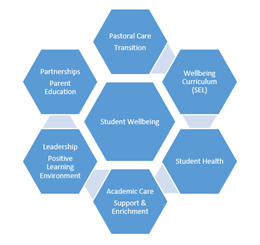
| Academic Welfare is developed through a sequenced K-12 Academic Welfare Program. Our traditional values of Mutual Respect, Integrity, Compassion and Excellence and our SOARING model of Positive Education are reflected in a whole-College approach to ensure student wellbeing. At JPC, we know students need to feel safe, valued, supported, and happy to achieve their academic potential.
Our priorities include: a welcoming and inclusive classroom climate
relationships that are positive, caring and respectful
clear values establishing behavioural and social expectations a whole College delivery of wellbeing.
|
Academic Welfare considers all of the aspects that combined underpin student wellbeing. This program has two critical aspects: Pastoral Care and Social and Emotional Learning (SEL, or the Wellbeing curriculum). SEL lessons link directly to the ACARA Personal and Social Capabilities. This learning is essential for students to navigate friendships, build resilience, practise social skills and develop social values. Classroom teachers will communicate what is learned in class news and updates under the sub-heading of Academic Welfare. These lessons will include managing emotions, bouncing back and building resilience, and understanding the value of humour, gratitude, and relationships.
We know the importance of providing a caring and safe environment and balancing care and order. In Primary School, the Pastoral Care teacher or Academic Welfare teacher is the classroom teacher, and they make strong personal connections with each student.
In Secondary School, Academic Mentors and Heads of Year support students. Academic Mentors build meaningful, lasting relationships to support student development and learning, both in and out of the classroom, and Heads of Year oversee programs and support students, staff, and the community.
We use student data, both academic and well-being, to get a clear and full picture of each student in our care, so we can best support their learning.
At JPC, academic welfare, well-being, and mentoring go hand in hand to ensure that each and every student is supported throughout their learning journey.
Primary
We provide clear and consistent expectations for behaviour in our JPC Behaviour Plan.
Application of consequences
The JPC Behaviour Plan provides a levelled system for behaviour management with consequences for inappropriate behaviour.
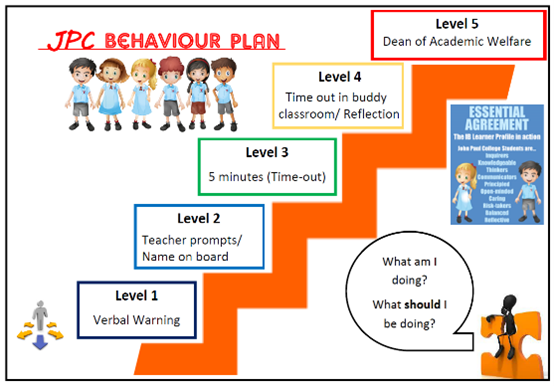
| Levels 1 - 3 include verbal and visual warnings and time out in the classroom or playground setting, allowing time and space for the student to 'reset' their behaviour choices. Restorative justice and Community Service may be used after a timeout in the classroom and include a verbal or written apology, picking up rubbish for part of the break, tidying up the room/port racks or doing a helpful job for someone impacted by the behaviour. The Primary School has no formal detentions. However, students may reflect with their teacher for part of their play or practise the correct behaviour as a consequence.
|
Level 4 includes timeout in a buddy classroom to complete a reflection in isolation after the behaviour continues and disrupts the class and the teacher's ability to teach. The 'buddy' teacher maintains supervision. The consequence may include restorative justice or Community Service. The teacher observing the behaviour will contact the student's parents or guardians to describe the behaviour, explain the strategies used, and explain how parents can support at home. Where difficulties have become significant, the Dean of Academic Welfare will support the teacher and a Behaviour Influence Card may be used.
Level 5 is for more serious behaviours or continued behaviour from previous levels. The Dean of Academic Welfare will meet with the student, considering their age, behaviour history, and student needs, discuss the behaviour, and contact the student's parents or guardians about the behaviour and consequences. A Behaviour Influence Card may be used.
An internal suspension may be required for severe breaches of College policy. Suspension is at the discretion of the Deputy Principal - Head of Primary in consultation with the Dean of Academic Welfare's recommendation. Discussion regarding ongoing enrolment may also be necessary if a student's behaviour seriously or wilfully contravenes student expectations and does not respond to the above processes.
2.5 SOARING
SOARING is JPC's model of Positive Education.

| Over the past two decades, research has intensified on what contributes to a flourishing life, such as feeling well and achieving well. It's called
Positive Psychology. Professor Martin Seligman and his colleagues strongly supported and widely promoted this work. The understanding generated from this research has been gradually filtered into an increasing number of schools known as
Positive
Education.
SOARING is JPC's model of Positive Education; we chose the image of a tree to show how we can all 'grow' our wellbeing, that it is an ongoing process, and that, like everything, cultivation and effort over time are important. SOARING is an acronym for six areas or elements of wellbeing. They appear at the top of the SOARING tree. Character strengths are those gifts we all possess in varying amounts. Practising these appropriately supports our wellbeing and that of those around us, much like a trunk supports a tree's canopy. They appear in the trunk of the SOARING tree. The SOARING model is embedded into our Academic Welfare Program and is consistent language across the entire College.
|
2.6 Bullying Prevention and ManagementJPC is committed to providing a safe, supportive and engaging College environment based on our core values of mutual respect, integrity, excellence and compassion. We celebrate diversity and recognise each person's unique character strengths. Every endeavour is made to promote a positive, caring and cooperative atmosphere, in which the rights and responsibilities of all members of the College community are acknowledged and upheld. Therefore, we do not tolerate bullying or harassment in any form.
We strive to create a positive learning environment where each member of the JPC family can flourish.
Bullying Prevention and Management Policy
2.7 Child Protection
Under legislation, duty-of-care obligations, and JPC's faith basis, the College is committed to providing a safe environment for all students and upholding their best interests and wellbeing.
This Policy and procedures set out the requirements for processes that protect students. It applies to all sexual and physical abuse complaints, other types of harm and inappropriate behaviour. The Child Protection Policy applies to all staff and students at the College.
2.8 Chaplaincy and Counselling
In today's rapidly changing society, our students are challenged daily to cope effectively and act responsibly; this challenge is often best met with the support of others. The Chaplain and the Academic Welfare Team provide the JPC family with the support needed to help young people reach their individual potential.
The College Counsellors provide professional counselling to students in partnership with families to ensure their social and emotional wellbeing, including:
- personal counselling
- group counselling
- group programs
- family and parent support and consultation
- teacher support and consultation regarding classroom strategies
- specialist educational and psychological assessment and diagnosis
- consultation with external professionals
- referral to external agencies and services
- classroom observations
- professional development for teachers
- personal support and counselling for staff members.
College counsellors work with families, staff, and other professionals to improve students' wellbeing and educational stability.
Students may refer themselves to the College counsellor or consultation may be sought at the suggestion of a teacher, parent and carer or friend. Parents and carers often seek advice from College counsellors about their child's wellbeing, educational success, behaviour, family situation or emotional concerns.
As with every part of our JPC experience, a partnership between College and home is crucial to our experience of success.
The Chaplain and Counsellors work together to provide students, families and staff with the coordinated support they need to lead healthy, fulfilling, productive and responsible lives.
A priority is the support of 'at risk' students and students with special needs and their families. This support may include the following:
- supportive and confidential environment
- initial individual and/or group counselling to support the educational, emotional, social, spiritual and personal needs of students
- development of support programs in areas of specific need (academic, careers, personal, behavioural)
- parent and teacher consultation regarding student needs
- classroom visits and support.
Confidentiality shows respect to and for the person seeking counsel, and it is a fundamental principle in all counselling situations. However, counsellors and the Chaplain cannot keep conversations confidential if a person is a danger to themselves or others. As John Paul College employees, we are also legally and morally obliged to report suspected abuse or neglect.
2.9 Leadership and Service
JPC has a progressive and dynamic leadership program that is based on a servant leadership model. Students are encouraged to explore and develop leadership roles in each of the relevant schools in the College. Students are encouraged to build their leadership skills through involvement in councils and committees, and by applying for formal leadership positions.
The Student Leadership Program at JPC aims to be:
- Educational - Students develop skills in leadership and communication
- Democratic - Every student has a voice
- Responsible - Students solve real problems and make real decisions
- Sharing - Students share with the school executive and teachers in the decision-making
- Caring - Students care about their College and what happens in it and to it
- Fun and Rewarding - Students experience enjoyment through successful participation
Every student of the College is considered a leader, representing the College through their actions, role modelling and service to others daily.
2.10 College Community Code of Conduct
The College Community Code of Conduct sets clear standards of behaviour expected of members of the College Community in the College environment or when attending any College-related function or activity at any other location.
The Code specifies the consequences for any member of the College Community who does not comply with these standards of behaviour.
2.11 Grievances Policy (Community)
The Grievances Policy (Community) aims to provide a mechanism for resolving concerns/complaints in a prompt, well-defined, consistent manner following the principles of natural justice, confidentiality and sensitivity.
This document sets out the internal procedures, both informal and formal, that apply within the College for responding to concerns. These procedures are designed to ensure that throughout the College, there is a transparent process for responding to fair, consistent, and prompt complaints.
2.12 Grievances Policy (Students)
The Grievances Policy (Students) sets out the internal procedures, both informal and formal, that apply within the College for responding to concerns. These procedures are designed to ensure that throughout the College, there is a transparent process for responding to fair, consistent, and prompt complaints.
The purpose of this Policy is to provide students with the opportunity to access and activate procedures to facilitate the resolution of a dispute or complaint.
2.13 Respectful Acceptance of Multi-faith and Cultural Practices
The Respectful Acceptance of Multi-Faith and Cultural Practices Policy seeks to outline the expectations of all students concerning participation in College life. This includes details about variations to uniforms and grooming, College attendance and levels of involvement.
2.14 Privacy Policy
Information is collected for the primary purpose of providing an education for your student. The College endeavours to gather the information reasonably and non-intrusively. Full and frank disclosure is required.
The secondary purposes related to the Privacy Policy include:
- To keep parents informed about matters related to their child's schooling through correspondence, newsletters and magazines
- Day-to-day administration
- Looking after students' social and medical wellbeing
- Fee payment
- Assessing hardship requests
- Seeking donations and marketing for the College
- To satisfy the College's legal obligations and allow the College to discharge its duty of care.
2.15 Admissions Policy
The purpose of this Policy is to outline the guidelines and processes for enrolment. The College demonstrates its commitment to meeting the educational needs of students in a manner that complies with relevant anti-discrimination and accreditation legislation and takes into account student learning needs while balancing the interests of all parties affected. This Policy covers students with exceptional needs or disabilities.
Related Policies: Domestic Admissions Policy